POLST = Provider Orders for
Life-Sustaining Treatment
The Kōkua Mau website is the central source for POLST information for Hawai‘i.
With input from local key informants, reviewing the national POLST form and best practice in other states, the Hawaiʻi POLST Task Force made improvements to our Hawaiʻi POLST Form. This change was approved by the DOH in May 2023. We encourage everyone to use the updated version of POLST (download link of PDF file below).
Download the official POLST Form for Hawaii as a PDF (90K, two sided.) Note: A POLST Form must be signed by a physician, APRN or PA licensed in the state of Hawai‘i to be valid.
September, 2025:
Based on community feedback we created a fillable/writable PDF file for the official POLST form for Hawai‘i. We hope it makes your work flow easier (and make readability easier, as well.) All appropriate fields can be filled out with tick marks or words. Keep in mind you can only choose one tick mark per section. The signature fields cannot be filled out electronically, since currently the POLST needs to be signed in person.
Please download the file ‘Hawaii_POLST_Form_fillable.pdf’. Fill it out in your in your computer or tablet, print it and sign it. Green paper is strongly recommended for EMS to find it quickly.
Please note: This PDF file is not a fillable web form. The PDF must be downloaded to your device to be filled out. Consequently, all information you put in inside your browser might be lost.
15-minute Video: Improved Hawaii POLST Form 2023 step-by-step essentials with Dr. Daniel Fischberg
- Learn about the 2023 Improvements of the Hawaiʻi POLST Form
- If you have the pre-May 2023 Hawaiʻi POLST version, it remains valid and does not expire. More about the Pre-2023 POLST Form.
What is POLST in a nutshell?
POLST (Provider Orders for Life-Sustaining Treatment) is a portable medical order that gives patients more control over their end-of-life care, as it documents the current treatment orders.
POLST documents ‘right now’ treatment orders.
POLST specifies the types of treatments a seriously ill or medically frail patient wishes to receive towards the end of life.
Completing a POLST form encourages communication between healthcare providers and patients, enabling patients to make more informed decisions.
The POLST form documents those decisions in a clear manner and can be quickly understood by all providers, including first responders and emergency medical services (EMS) personnel. As a result, the patient’s wishes can be honored across all settings of care.
Remember: Everyone needs an Advance Health Care Directive
Not Everyone needs a POLST
- Click here for a chart with the differences between an Advance Directive and a POLST. Or download a PDF of the differences.
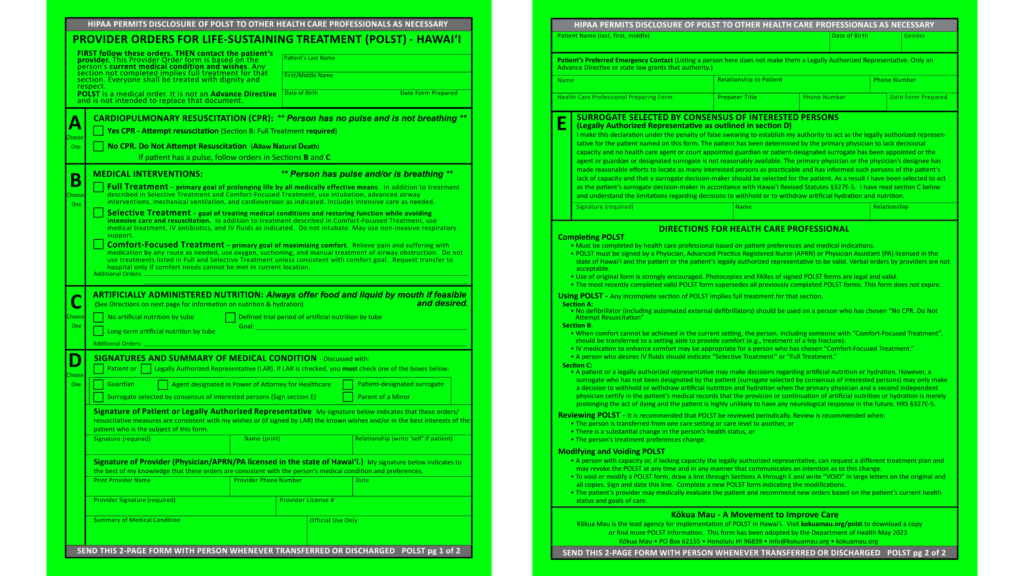
The POLST form is usually completed on distinctive bright lime-green paper and must be two-sided. The bright green color is to make the form quickly visible to families and emergency medical services personnel.
The lime-green color is also easily copied on green or white paper. We recommend Ultra Lime No. 104034 from Mohawk Britehue 60 text at Fisher Hawaii. The form is acceptable in black and white. A copy is a valid document as well.
- 2018: National POLST Paradigm identifying those who are appropriate for POLST
- POLST: Doing it Better is a new free POLST Video (7 Min 22 sec) available from the National POLST office. This excellent short video nicely summarizes the essentials of POLST.
- See also: Frequently Asked Questions: A Consumer Guide to POLST for Hawai‘i
A Provider’s Guide to POLST:
- A Provider’s Guide to POLST as PDF (two sided,1 MB)
- Download the Consumer Guide to POLST as a PDF file (two sided 1MB) more
What is POLST?
POLST (Provider Orders for Life-Sustaining Treatment) is a medical order that gives patients more control over their end-of-life care. It specifies the types of treatments that a patient wishes to receive towards the end of life. Completing a POLST form encourages communication between healthcare providers and patients, enabling patients to make more informed decisions. The POLST form documents those decisions in a clear manner and can be quickly understood by all providers, including first responders and emergency medical services (EMS) personnel. As a result, the patient’s wishes can be honored across all settings of care.
Is the POLST simply a DNR ?
No, POLST is a document that empowers a patient or their legally authorized representative (see below) to make decisions along the whole continuum of care, from very aggressive, life sustaining care, to comfort care only, including choices about full resuscitation or do not attempt resuscitation.
Is POLST the same as an Advance Health Care Directive?
No, POLST does not replace an Advance Health Care Directive (AHCD). The AHCD can provide significantly more detail about an individual’s wishes and preferences for treatment. In addition, the AHCD is the most common mechanism for designating a legally authorized representative decision maker for the patient.
Will the CCO-DNR Bracelet still be honored by EMS?
Yes, the CCO-DNR Bracelet is still a valid method to communicate a person’s intent about attempts to resuscitate. There are still thousands of these bracelets in use, and EMS personnel will continue to honor this directive.
Why is the POLST form lime green?
The POLST form is usually completed on a distinctive bright lime-green form, but is also available from the internet (here on our website) and is acceptable in black and white. The bright color is to make the form quickly visible to families and emergency medical services personnel. The lime-green color is also easily copied. A copy on white paper is a valid document.
Does the POLST form travel with the patient between settings of care?
Yes, the POLST form is designed to be a standard form that may be accepted by all providers across the state. As a legal medical order, it will be honored by EMS. Hospitals, long-term care facilities, home care and hospice providers may also voluntarily honor the form and include it into their medical records. However, providers with electronic medical records may choose to adapt the essence of the orders into their specific system. Hospital discharge planners are encouraged to support the completion of the POLST form (when clinically appropriate) as a part of their daily practice.
Is implementing the orders from the POLST form protected under Hawaii Law?
Yes. The law states that no provider will be subject to criminal prosecution and civil liability for carrying out the treatment orders in good faith or for performing cardiopulmonary resuscitation if the person performing CPR was unaware of the POLST order to not attempt resuscitation or they believed that the treatment orders (including the DNR order) had been revoked or canceled.
How do providers get more copies of the POLST form?
The form is freely available here in PDF format (600K) for easy replication. It is the standard that the form be on an 8½” X 11” sheet of lime colored paper. The form must have both sides copied on the front and back of the paper.
Where is the family encouraged to keep the form?
For the patient at home, the POLST form should be kept in a place readily accessible by family members. Examples include on the refrigerator, in the medicine cabinet, on the back of a bedroom door or on a bedside table. It should be kept with the AHCD.
Which patients should complete a POLST form?
It is recommended that a patient with a chronic debilitating disease, a seriously ill patient, or a terminally ill patient have both an Advance Health Care Directive and a signed POLST form. Both forms should be kept together
Who can explain the POLST form and fill it out?
The patient’s physician, APRN (Advanced Practice Registered Nurse), PA (Physician Assistant) or another health care provider must explain to the patient or Legally Authorized Representative the nature and content of the form, including any medical interventions or procedures. Additionally, the provider must also explain the difference between the POLST form and an Advance Directive. The physician, APRN, PA or other healthcare provider may prepare (or fill in) the form, but it MUST be signed by the patient’s physician, APRN or PA and the patient or their Legally Authorized Representative in order to be valid.
Which Physician, Advanced Practice Registered Nurse (APRN) or Physician Assistant (PA) should be signing the POLST form?
The law stipulates that the physician, APRN or PA who is co-signing the POLST form with the patient or their Legally Authorized Representative must be a physician, APRN or PA licensed in the state of Hawai‘i and must have examined the patient. The intent of this definition is to assure that there has been a professional relationship between the patient and physician, APRN or PA.
What is a Legally Authorized Representative (LAR)?
This is someone who is able to make decisions for the patient when they are not able to make decisions on their own. A Legally Authorized Representative can be 1) an agent designated by the patient through a Power of Attorney for Healthcare, 2) a guardian, 3) a surrogate designated by the patient when the patient is still able to make that decision, or 4) a surrogate designated by consensus of interested persons. If a patient is not able to make decisions on their own, the patient’s primary physician determines that is the case. After that, efforts are made to find all the people who have exhibited special care and concern for the patient and are familiar with the patient’s wishes. Some of these people may include a spouse who is not separated or estranged, parents, and children, but interested persons do not necessarily need to be related by blood or marriage. This group of people select a surrogate decision maker by consensus. This is in accordance with HRS 327E-5.
What decisions can be made by a Legally Authorized Representative?
A Legally Authorized Representative can make all decisions that the patient would make on their own behalf with one exception. This exception is that the surrogate appointed by consensus in accordance with HRS 327E-5 has limitations placed upon him or her about decisions about withholding or withdrawing artificial nutrition and hydration. The surrogate by consensus can only make the decision to withhold or withdraw artificial nutrition and hydration if two physicians independently certify in the patient’s medical records that the artificial nutrition and hydration only prolongs the act of dying and the patient is highly unlikely to have any neurological response in the future.
When should the POLST form be reviewed?
The physician, APRN or PA should review the POLST form with the patient or their Legally Authorized Representative whenever there are substantial changes in the health status, when there is a transfer from one setting to another or when the goals for treatment change.
How is the form modified or voided?
A patient or their Legally Authorized Representative may revoke or void the POLST form in any manner that communicates that intent. The form may also be voided by drawing a line through the front of the page (sections A-E) writing “VOID” in large letters on the original and copies, and signing and dating that action.
- A Provider’s Guide to POLST as pdf (two sided, 600K)
Information about POLST for Consumers
The Hawai‘i POLST Form is available for free here at Kōkua Mau.
We translated key Kōkua Mau documents in 13 languages, including the Hawai‘i POLST Form and the POLST Information.
- Multilingual POLST Form for Hawai‘i
- Multilingual Consumer Guide to POLST
Hawaiʻi POLST Legislation Timeline
- Looking for POLST Information for other States besides Hawai‘i?
- Hawai‘i was the seventh State to pass a POLST law. Please visit POLST.org to see if and what form of POLST might be offered in other States.
Questions about the ‘comfort care only‘ bracelet or necklace (DNR bracelet) that was available in Hawaiʻi in the past? The Department of Health stated that the CCO-DNR Bracelet program has been suspended indefinitely. Link to the DOH information of the DNR suspension